Start-Up
Mobile-first
UX Strategy
A meal planning companion for Indian households
Reducing the daily 'what do I cook' decision to under a minute — for every household type.
ROLE
UX Designer · Product Thinker
PLATFORM
iOS & Android
FOCUS
Strategy · Architecture
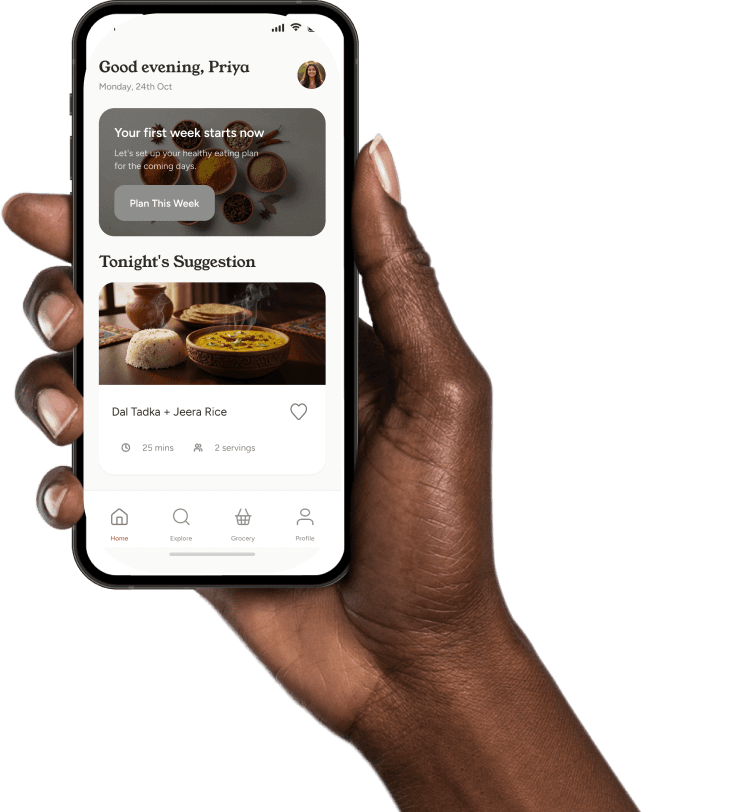
The Outcome
The PROBLEM
Across millions of Indian households, this question triggers a mental calculation that involves dietary constraints, yesterday's meals, available ingredients, and the energy of the cook, all at the worst possible moment of the day.
No one talks about how draining this is. And no existing product has been designed to solve it, especially not for the Indian context.
No persistent context : dietary restrictions, recent meals, and personal preferences live only in one person's head, and must be re-evaluated from scratch each time.
Decision fatigue, not lack of options: the problem isn't a shortage of recipes; it's that choosing among them while accounting for constraints, energy, and mood is quietly exhausting.
One-size household assumption: existing tools are built for enthusiastic meal-preppers, not the single person eating alone on a Tuesday or the couple who just want something reasonable after work.
Repetition by default: without support, people don't pick their favorite meals, they pick the path of least resistance — cycling through the same 4–5 dishes until cooking feels like a chore.
74%
feel blank 2–3 times a week
65%
carry all food decisions alone
0%
currently
use a meal planning app


आज क्या बनाएं?
"What should I cook today?" — in every Indian home, every evening




Multi-person household profiles
All competitors treat the household as one user. None store per-member profiles and resolve conflicts.
Per-person allergy/prefrence tracking
Mealime filters at household level. None can track Person A as peanut-allergic while Person B is lactose-intolerant.
Repetition tracking
No app warns against meal repetition. Only noticed once it happens, and pointed out by someone else.

Core Insight
The meal decision isn't a recipe problem. It's a cognitive load problem with 7–12 simultaneous variables.
Design Principle
Smart defaults, easy overrides. The app does the thinking; the user has the final word in one tap.
Cultural Constraint
Indian meals are multi-dish units. Any product that treats them as single dishes fundamentally misunderstands the cooking logic.
User Personas
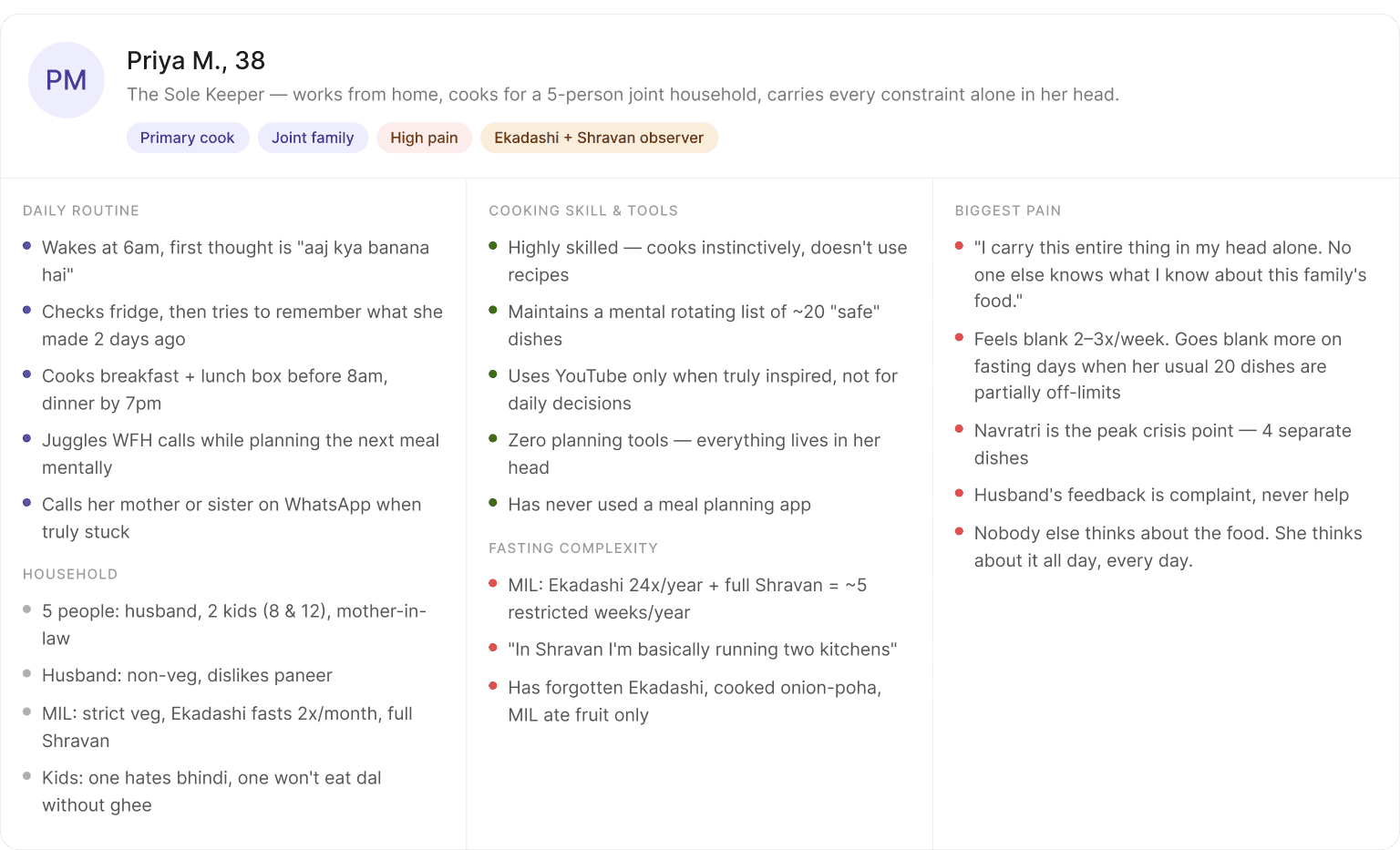
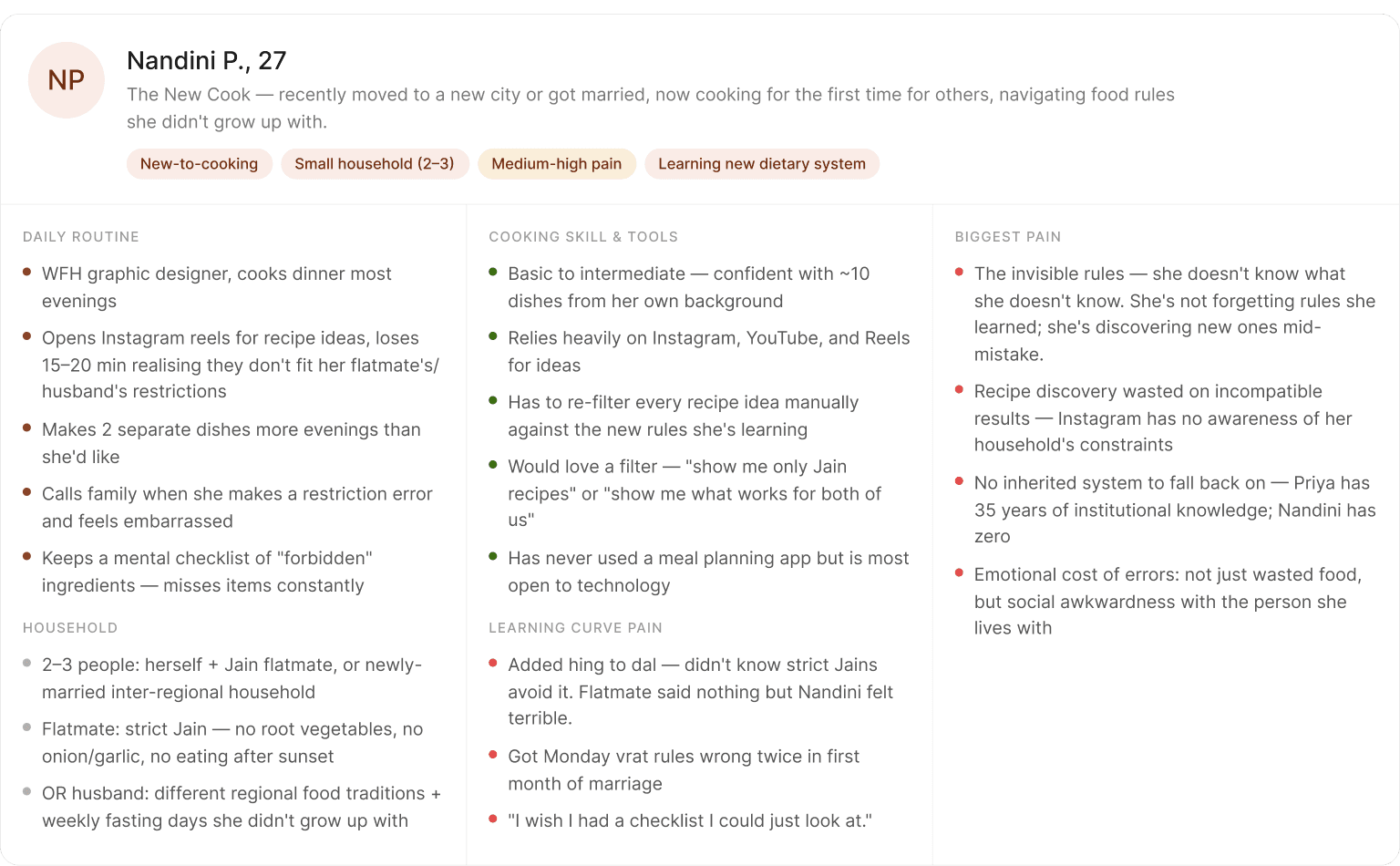
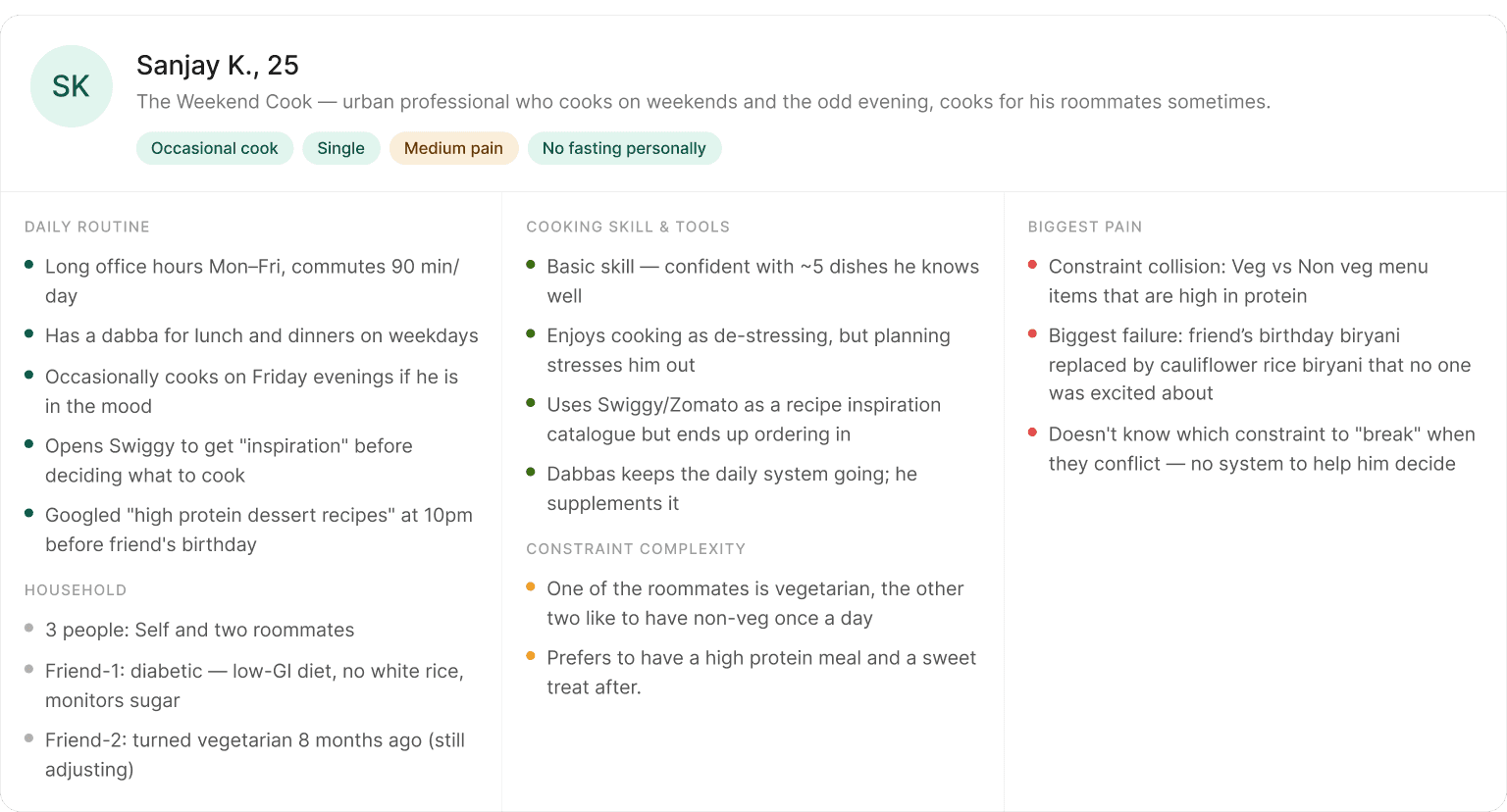
Household Profiles
Core
Set up once: family size, dietary categories (Jain, Veg, Non-veg, Satvik), allergies, and regional preferences. Every suggestion adapts to your household automatically.
Multi-Dish Meal Units
Core
Unlike Western apps that plan single dishes, Daily Dish understands the dal-sabzi-roti unit. Meals are planned as complete thali combinations.
3-Tap Meal Decision
Key Flow
Open app → See today's suggested meals → Approve or swap. Decision time under 60 seconds, designed for exhausted evenings.
Smart Grocery List
Auto-generates a categorized grocery list from approved meals. Adjusts quantities for household size and flags what's likely already in your pantry.
Rotation Intelligence
Learns what you made last week, this season, and avoids repetition automatically. No configuration required.
Weekly Prep Mode
For batch-cooking households: plan the full week, generate a consolidated prep list, and sequence steps to minimize kitchen time.
The typefaces
Young Serif
Display & Branding
Aa
Weights
Regular (400)
Character Set
AaBbCcDdEeFf 0123456789
Warm, approachable serif with character. Used for page titles (H1–H3), hero text, and brand-forward moments. Avoids the overused startup-SaaS look of Poppins.
Figtree
Body & Interface
Aa
Weights
Light · Regular · Medium · Semi Bold · Bold
Character Set
AaBbCcDdEeFf GgHhIiJjKkLl 0123
Rounded-humanist sans-serif. Friendlier than Inter, excellent legibility at small sizes. Carries all body text, buttons, labels, captions, and navigation.
Noto Sans Devanagari
Regional Support
अआ
Weights
Regular · Medium · Semi Bold · Bold
Character Set
क ख ग घ ङ च छ ज झ ञ ट ठ ड ढ ण
Pairs with Figtree for Hindi dish names and regional UI labels. Taller line-height accounts for Devanagari ascenders/descenders.


The Wireframes
Onboarding Flow
The previous industry default asks users to sign in before they've experienced anything. Rasa inverts this. Show what the product does, let the user feel it, and only ask for information when they have a reason to give it.
Sign-in moves from the door to after setup — when the user has something worth saving. At that point, signing in feels like protecting their work, not paying an entry fee.


Other Projects

Contri App
CASE STUDY | MOBILE
A smart, social budgeting tool that simplifies managing and tracking shared expenses with ease.
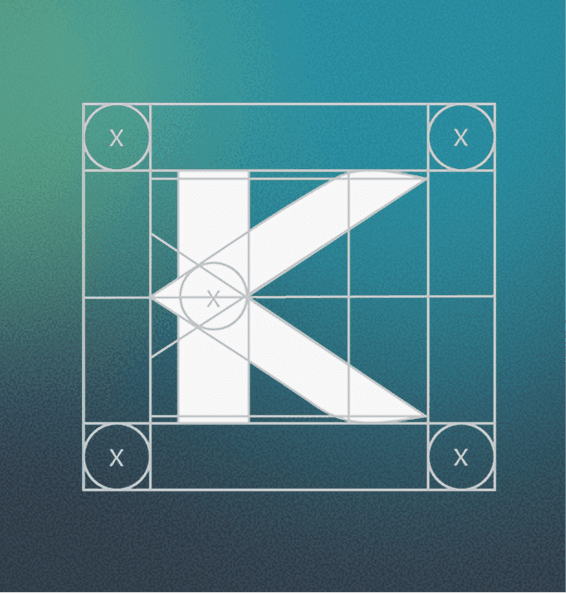
Kadac Brand Design
Brand Identity | Logo Design
A clean, modern exploration of brand identity that blends strategy, visual storytelling, and impactful design